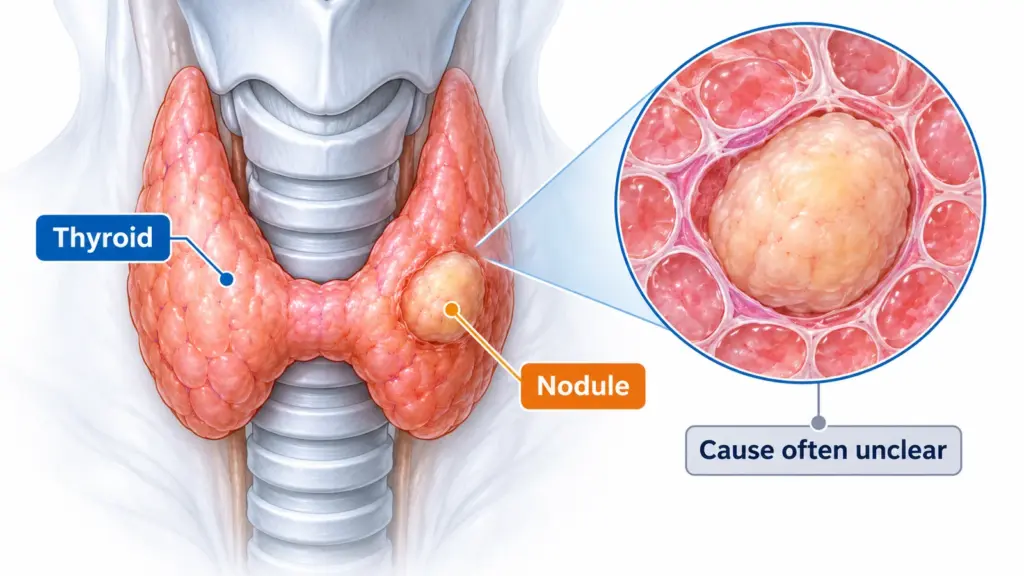
Most thyroid nodules do not have one identifiable cause. They can develop as localized overgrowths of thyroid tissue or include fluid-filled areas. Age, family tendency, thyroid inflammation and iodine status may be relevant, but finding a nodule does not prove that you did something wrong or need a supplement.[1,2]
I find it useful to separate “Why did this develop?” from “What should happen next?” The exact origin may remain uncertain while the next step becomes clear from the examination, ultrasound and thyroid blood tests. A possible cause does not establish whether an individual nodule is benign.
This article focuses on causes, risk factors and common misconceptions in adults. It is not a diet plan or a guide to every thyroid disease. The goal is to help you give a useful history and avoid treating an assumed cause before the nodule has been properly assessed.
What changes within the thyroid can produce a nodule?
The thyroid is a gland made of hormone-producing tissue. A localized area can grow differently from its surroundings and become a discrete nodule. A nodule may contain mainly tissue, mainly fluid or a mixture. These descriptions explain its structure, rather than a single reason why it appeared.
“Solid” is not another word for cancer, and “cystic” does not remove the need to understand the complete report. The clinician considers the overall imaging pattern. Some fluid-filled areas arise within an existing nodule, so different appearances may reflect a mixture of processes rather than completely separate diseases.
One person can have several nodules with different features. That does not mean all share the same significance or need the same next step. It is more helpful to identify which finding is being assessed than to treat the word “nodules” as a single diagnosis applying uniformly across the gland.
How do age and family history fit into the picture?
Nodules become more common with age and can occur in members of the same family. These are background tendencies. They cannot explain exactly when a particular nodule formed, and they are not instructions to screen every relative with ultrasound.
When giving your family history, distinguish an overactive thyroid, an enlarged thyroid and thyroid cancer. If possible, note which relative was affected and the specific diagnosis. A vague report that “thyroid trouble runs in the family” is a starting point for questions, not a risk category.
Finding a nodule in an older report may help establish how long it has been present. A newly noticed nodule is not necessarily newly formed. Comparisons should use the actual images and measurements where available, since increased scanning can reveal findings that were previously unnoticed rather than recently caused.
Can Hashimoto’s disease cause or accompany nodules?
Hashimoto’s disease is an autoimmune condition in which the immune system affects the thyroid. It may coexist with nodules, and inflammation can make the gland look uneven on ultrasound. Distinguishing a true discrete nodule from background changes requires interpretation of the examination and images.[3]
A history of thyroiditis does not prove that every lump is inflammatory or harmless. Equally, the presence of a nodule does not establish Hashimoto’s disease. Blood tests and the clinical picture address the gland’s function and possible autoimmune background; imaging characterizes the focal finding.
If you already receive thyroid medication, bring the name and current prescription to the appointment. Ask whether the nodule and the thyroid function problem need separate follow-up. Do not assume that increasing medication will shrink a nodule, and do not change a prescribed dose to pursue that aim.
Is iodine deficiency always the explanation?
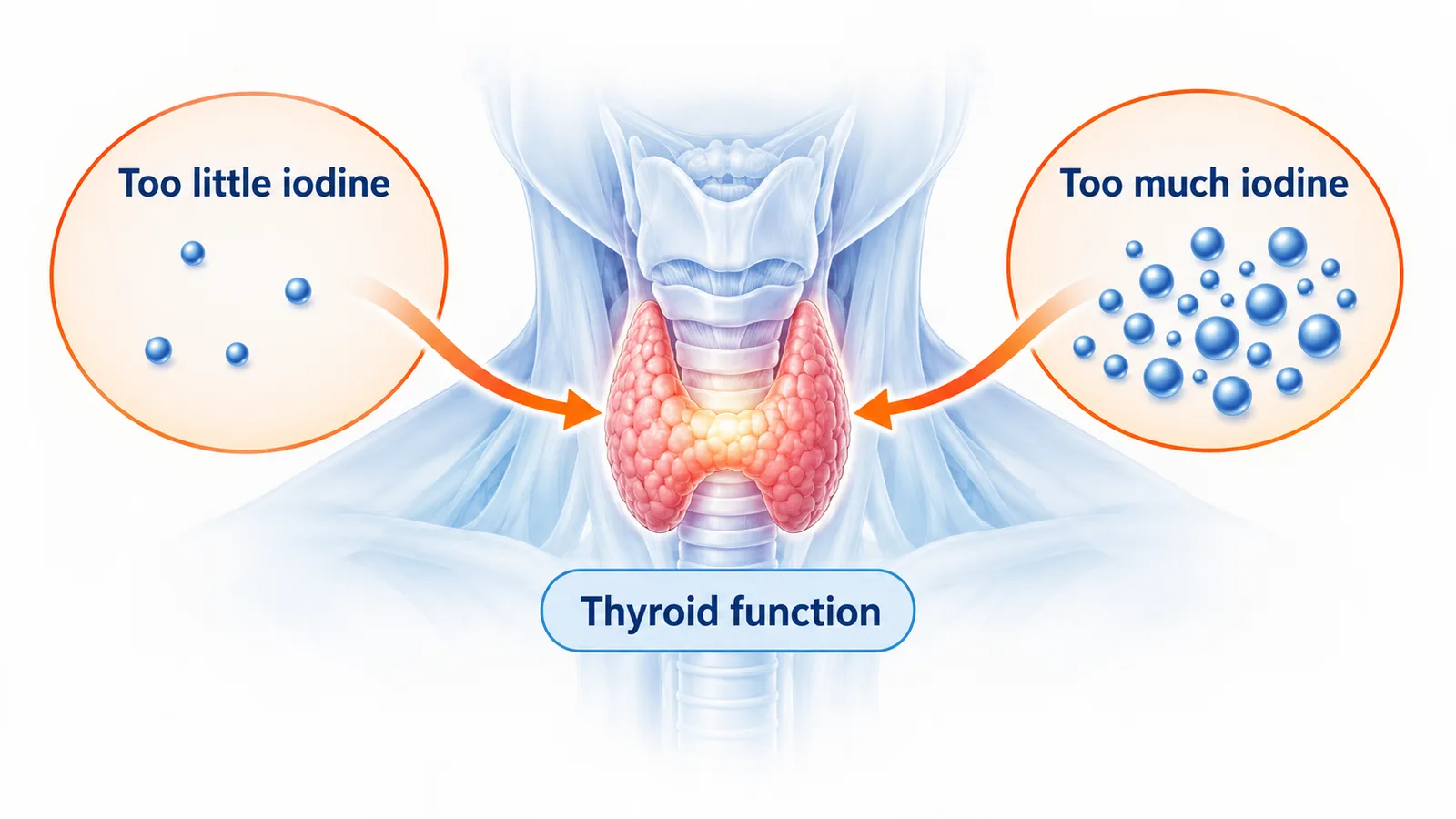
No. Iodine deficiency can contribute to thyroid enlargement and nodular disease, but its relevance varies by region and personal circumstances. In iodine-sufficient settings it should not be assumed to explain every nodule. Taking more iodine without understanding the situation is not a reliable solution.[4]
Excess iodine can disrupt thyroid function, particularly in susceptible people. Kelp products and “thyroid support” mixtures may contain substantial iodine or other ingredients. Mention them during assessment even if they are sold as natural products. A nodule is not evidence that your body is asking for a particular supplement.
Nutrition advice should reflect actual needs, including any pregnancy-related requirements, rather than an attempt to dissolve a lump. Ask a qualified clinician about suspected deficiency. A spot of uncertainty about diet should not divert attention from a report that recommends further diagnostic evaluation.
Are hormone-producing nodules and cancer risk the same issue?
Some nodules produce thyroid hormone independently of normal control. A low thyroid-stimulating hormone result can lead to further assessment, sometimes including a radionuclide scan. That test answers a functional question and is different from diagnostic ultrasound. Many nodules have normal function.[5]
Separately, childhood head or neck radiation and certain inherited or family cancer histories can affect the assessment of malignancy risk. These are reasons to provide a careful history, not proof that a nodule is cancerous. They should not be presented as explanations for all common benign nodules.[6]
Say what type of radiation exposure occurred, if known, and when. Therapeutic radiation in childhood is different from having had an ultrasound, which does not use ionizing radiation. Avoid assuming that any medical scan explains the nodule. If records are incomplete, state what is known and let the clinician clarify the relevance.
How I put a possible cause into the treatment discussion
When someone asks what caused their nodule, I want to understand the concern behind the question. Often it is whether the finding could have been prevented, whether it is dangerous, or whether changing a habit could remove the need for treatment. I explain which parts of that question the available evidence can answer.
My treatment discussion begins with the nodule’s clinical significance, rather than a presumed cause. Symptoms, documented growth, appearance, hormone production and reliable benign assessment matter. I do not regard an unexplained origin as an indication for ablation, and a familiar label such as thyroiditis is not a substitute for evaluating suspicious findings.
If a benign nodule is causing an important problem, I consider its solid or cystic composition when discussing options. A mainly fluid-filled lesion raises a different discussion from a solid one; observation, surgery, radioactive iodine and appropriate ablation methods have different purposes and limitations. I want the chosen step to address a defined problem, while being clear that it may not explain why the nodule originally developed.[7,8]
What information is worth bringing to an appointment?
Check the ingredients of nonprescription products rather than bringing only a brand name. “Support” or “balance” on a label does not identify what a product contains. Tell the clinician when you started it and why, without assuming it caused or cured the finding. If family details are unclear, a short written note about what relatives actually remember can be helpful. You do not need to obtain every missing record before seeking assessment of a new lump or a concerning report.
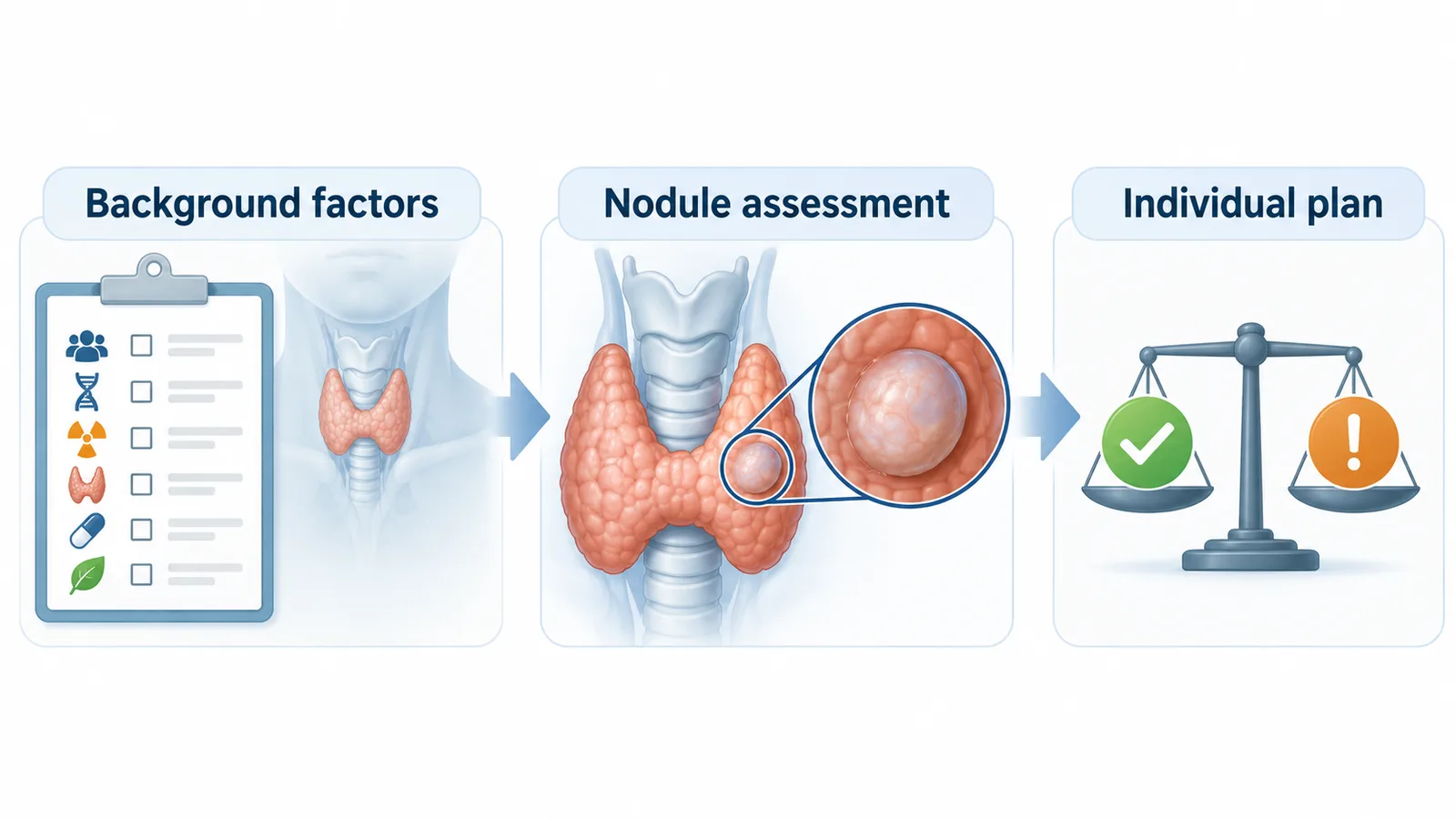
Bring ultrasound reports and any previous biopsy results. Include a medication and supplement list, relevant family diagnoses and earlier neck treatment. A short timeline can distinguish a recent discovery from a documented change. Note pressure, swallowing symptoms, voice changes or signs of altered thyroid function.
Ask which question remains unanswered: the origin of the nodule, its imaging risk, its hormone production or whether it explains a symptom. These are related but distinct. You may receive a clear follow-up recommendation even when the original cause cannot be identified.
There is no need to prepare a theory that explains every detail. Reporting uncertainty honestly is useful. If a clinician recommends observation, ask what is being monitored and what would change the plan. If testing is recommended, ask what the result would help decide before assuming a procedure is inevitable.
Conclusion
Thyroid nodules can develop in several settings, and the cause of an individual finding often remains uncertain. Age, family history, thyroid inflammation and iodine status may matter, but none replaces assessment of the nodule itself. Avoid self-prescribing a supplement or attributing the finding to one habit without evidence.
Frequently Asked Questions
Did I cause my thyroid nodule?
Usually no single cause can be identified. Finding a nodule is not evidence of a personal mistake. Focus on obtaining the appropriate assessment rather than assigning blame.
Does Hashimoto’s disease make every nodule benign?
No. Autoimmune thyroid disease and a discrete nodule can coexist. The nodule still needs interpretation in its own imaging and clinical context.
Should I take iodine to shrink a nodule?
Not on the basis of a nodule alone. Both deficiency and excess can affect thyroid health. Discuss suspected deficiency and existing supplements with a clinician.
Can stress or one food explain the lump?
There is no sound basis to assign an individual nodule to a stressful period or one food from timing alone. Avoid restrictive diets or detox claims that promise to dissolve it.
Does a family history mean I will need surgery?
No. The exact family diagnosis may affect assessment, but surgery is not determined by family history alone. Bring any available details rather than assuming the outcome.
Can the next step be clear when the cause is unknown?
Yes. Ultrasound, thyroid function and relevant clinical information can support observation or further investigation even when nobody can identify why the nodule first formed.
Scientific References
- American Thyroid Association. Thyroid Nodules [Internet]. Accessed 2026 Oct 29.
- Endocrine Society. Thyroid Nodules [Internet]. Accessed 2026 Oct 29.
- National Institute of Diabetes and Digestive and Kidney Diseases. Hashimoto’s Disease [Internet]. Accessed 2026 Oct 29.
- National Institutes of Health, Office of Dietary Supplements. Iodine: Fact Sheet for Health Professionals [Internet]. Accessed 2026 Oct 29.
- Durante C, Hegedüs L, Czarniecka A, et al.. 2023 European Thyroid Association Clinical Practice Guidelines for thyroid nodule management. Eur Thyroid J. 2023;12(5):e230067. doi:10.1530/ETJ-23-0067.
- National Cancer Institute. Thyroid Cancer Treatment (PDQ®)–Patient Version [Internet]. Accessed 2026 Oct 29.
- Sinclair CF, Baek JH, Hands KE, et al.. General Principles for the Safe Performance, Training, and Adoption of Ablation Techniques for Benign Thyroid Nodules: An American Thyroid Association Statement. Thyroid. 2023;33(10):1150-1170. doi:10.1089/thy.2023.0281.
- Papini E, Monpeyssen H, Frasoldati A, Hegedüs L.. 2020 European Thyroid Association Clinical Practice Guideline for the Use of Image-Guided Ablation in Benign Thyroid Nodules. Eur Thyroid J. 2020;9(4):172-185. doi:10.1159/000508484.