Treatment · Venous
Pelvic Congestion Syndrome
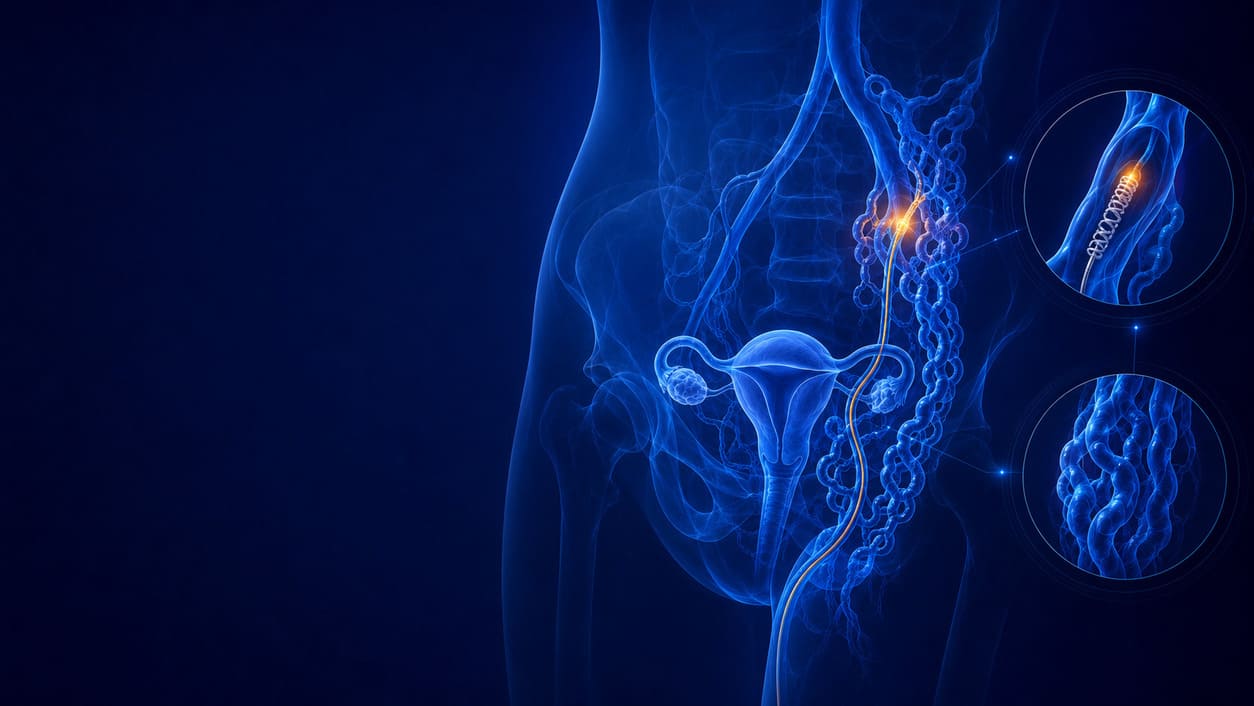
Chronic pelvic pain caused by insufficient ovarian and pelvic veins is treated by closing those veins from within, through a single puncture, as a day case.
Who it is for
PCS is considered when pelvic pain has lasted more than six months, is worse on standing or towards the end of the day, and comes with deep discomfort during or after intercourse, vulvar or thigh varices, or leg veins that reappear after treatment.
The diagnosis is confirmed on Doppler ultrasound, CT or MR venography, and gynaecological causes are excluded first. Many patients arrive at this point after years without an explanation.
Risks and alternatives
Possible risks
Pelvic aching may increase temporarily. Bleeding or infection can occur; rarely, embolic material may move to the lungs. Pain may persist or return, especially if another cause of pelvic pain is present.
Other options
Assessment for other causes of pelvic pain, symptom management and gynaecological treatment where appropriate. Embolization is considered only after the venous diagnosis is supported.
Clinical source: CIRSE
How the procedure works
Access
A puncture at the neck or groin under local anaesthetic; a catheter is advanced to the ovarian and internal iliac veins.
Venography
Contrast demonstrates the reflux and the collateral network filling the pelvis, on both sides.
Embolization
Coils, and where needed a sclerosant, close the incompetent veins along their length. Normal drainage takes over.
Recovery
Two to four hours of observation, then discharge. A mild pelvic ache for a few days is expected.
Compared with surgery
| Aspect | Embolization | Surgical ligation |
|---|---|---|
| Incision | 2 mm puncture | Laparoscopic ports or incision |
| Anaesthesia | Local | General |
| Both sides at once | Routine | Longer operation |
| Hospital stay | Day case | 1–2 nights |
| Return to work | 2–3 days | 2–4 weeks |
General guidance only. Suitability, benefit and risk are assessed individually from your own imaging.
Questions patients ask
Does closing these veins affect my ovaries or hormones?
The veins carry blood away from the ovaries; the arterial supply and ovarian function are not disturbed. Hormone levels are not expected to change.
How soon does the pain improve?
Most improvement appears over the first one to three months as the congestion settles, rather than immediately. Progress is reviewed at each follow-up.
Can it be done if I still want children?
Yes. Embolization of the ovarian veins does not interfere with the uterus or the ovaries, and pregnancy afterwards is documented.
Why was this missed for so long?
Pelvic congestion is not visible on standard supine imaging unless it is specifically looked for. It is often diagnosed only when the venous phase is reviewed with the question in mind.
Will vulvar or leg varices disappear?
Vulvar and upper thigh varices usually reduce once the pelvic source is closed. Any remaining surface veins can be treated locally afterwards.