Treatment · Non-vascular
Thyroid Nodule Ablation
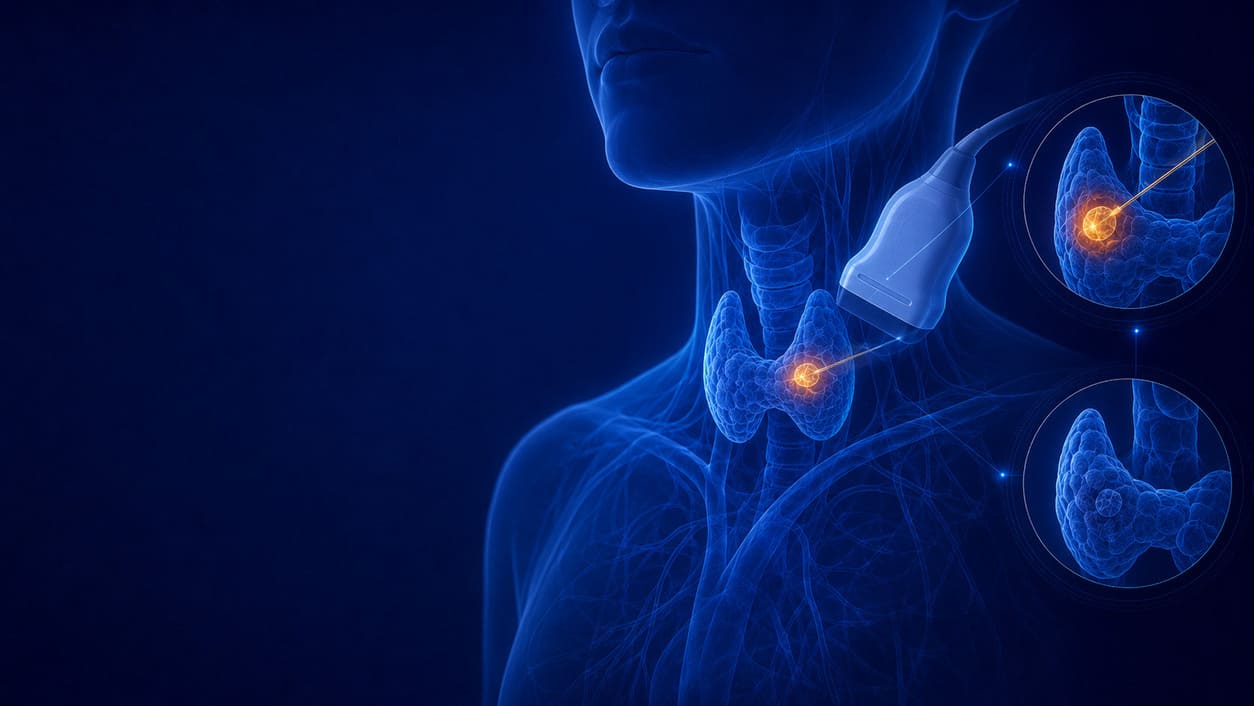
Benign thyroid nodules are shrunk with radiofrequency energy delivered through a needle under ultrasound guidance. No incision, no scar on the neck, and no lifelong hormone replacement.
Who it is for
Ablation is offered for nodules proven benign on fine-needle aspiration that cause visible swelling, a feeling of pressure or tightness in the throat, difficulty swallowing, hoarseness or cosmetic concern — and for autonomous nodules causing hyperthyroidism.
It is not a treatment for thyroid cancer or for nodules with indeterminate cytology, which are managed differently. At least one, usually two, benign biopsy results are required before ablation is planned.
Risks and alternatives
Possible risks
Pain, swelling, bleeding or skin injury can occur. Voice change from nerve irritation is an important uncommon risk. The nodule can regrow and may need another procedure; a suspicious nodule requires cancer assessment, not routine ablation.
Other options
Ultrasound follow-up for a benign nodule without troublesome symptoms, or surgery when appropriate. Thyroid function and biopsy findings guide the choice.
Clinical source: ATA
How the procedure works
Assessment
Ultrasound measures the nodule in three planes and confirms its relation to the trachea, the vessels and the recurrent laryngeal nerve.
Anaesthesia
Local anaesthetic in the skin and around the thyroid capsule. You remain awake and can speak throughout.
Ablation
A fine electrode is moved through the nodule under live ultrasound, treating it in small units while the surrounding gland is protected.
Recovery
Ice and observation for an hour or two, then discharge. Mild neck soreness for a few days.
Compared with thyroid surgery
| Aspect | Radiofrequency ablation | Surgery (lobectomy) |
|---|---|---|
| Incision | Needle | Neck incision |
| Anaesthesia | Local | General |
| Scar | None | Visible on the neck |
| Hormone replacement | Not expected | Often required |
| Return to work | 1 day | 1–2 weeks |
General guidance only. Suitability, benefit and risk are assessed individually from your own imaging.
Questions patients ask
How much does the nodule shrink?
Volume reduces over six to twelve months rather than immediately, and the degree depends on the size and composition of the nodule. Control ultrasound at three, six and twelve months tracks it.
Could a second session be needed?
Large nodules are sometimes treated in two sessions. If that is likely in your case, it is planned and explained before you travel.
Will my voice be affected?
Hydrodissection separates the nodule from the recurrent laryngeal nerve, and because you speak during the procedure the nerve is monitored continuously. Hoarseness is uncommon and usually temporary.
Do I still need thyroid medication?
Ablation targets the nodule and preserves the rest of the gland, so replacement is not normally required. Thyroid function is checked at each follow-up.
Can cystic nodules be treated?
Yes. Predominantly cystic nodules are aspirated and then treated, often with a very good volume response.