Treatment · Vascular
Hemorrhoid Embolization
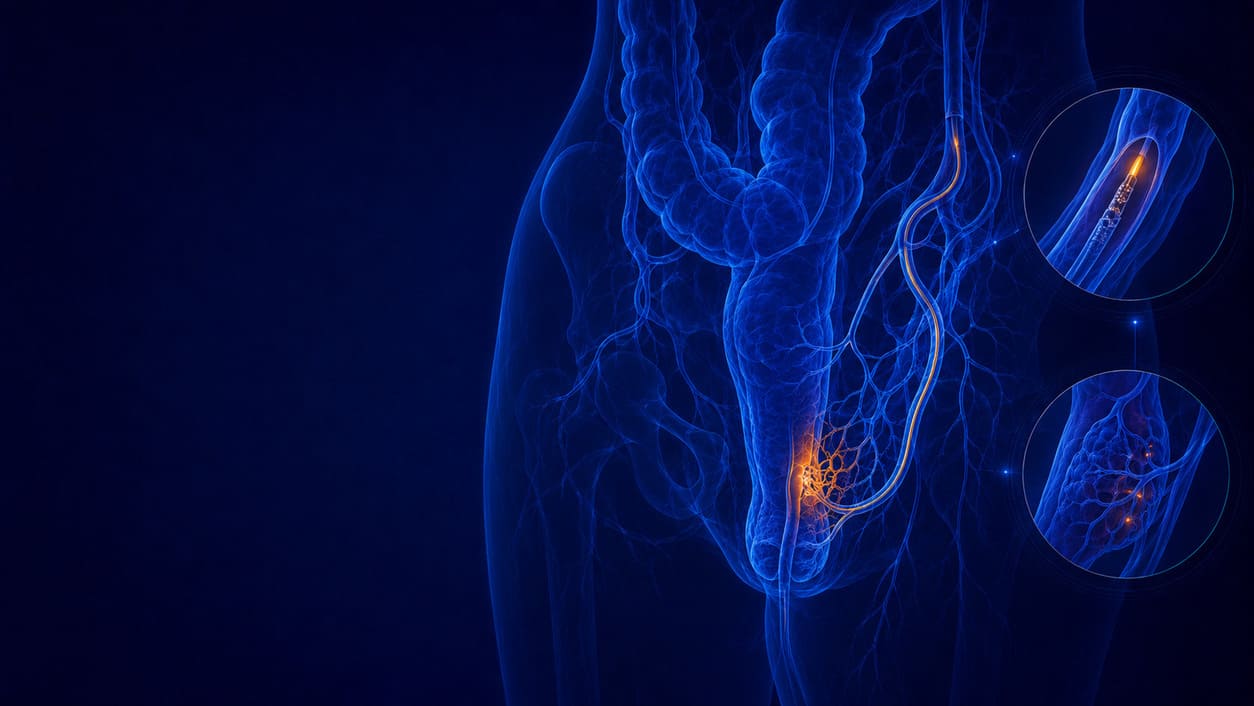
The Emborrhoid technique treats bleeding haemorrhoids by reducing the arterial inflow, from inside the vessel. There is no wound in the anal canal and none of the painful recovery that follows conventional surgery.
Who it is for
Embolization is used mainly for recurrent bleeding from grade I–III haemorrhoids, particularly when the blood loss has caused anaemia, when rubber-band ligation has already failed, or when surgery carries added risk because of anticoagulation or other conditions.
Prolapse is not corrected by embolization; large prolapsing haemorrhoids are better treated surgically, or in combination. A colonoscopy to exclude another source of bleeding is required beforehand.
Risks and alternatives
Possible risks
Bleeding or bruising at the catheter site may occur. Rectal ulceration or reduced blood supply to the bowel are important potential harms; bleeding may persist and another treatment may be needed.
Other options
Fibre, stool-softening measures and medicines, rubber-band ligation or other office procedures, and surgery when indicated. Rectal bleeding needs assessment for other causes.
NICE considers the evidence on safety and benefit insufficient and recommends this procedure only in a research setting in the UK. Any proposal here needs an individual discussion of this uncertainty.
Clinical source: NICE
How the procedure works
Access
A puncture at the wrist or groin under local anaesthetic. Nothing is introduced through the anal canal.
Mapping
The superior rectal artery and its branches are displayed with angiography.
Embolization
Coils or small particles reduce the arterial inflow to the haemorrhoidal cushions, while the rectal wall keeps its collateral supply.
Recovery
A few hours of observation, then discharge. Normal activity the following day.
Compared with haemorrhoidectomy
| Aspect | Embolization | Haemorrhoidectomy |
|---|---|---|
| Wound | None | Open wound in the anal canal |
| Anaesthesia | Local | General or spinal |
| Pain afterwards | Minimal | Often significant for 1–2 weeks |
| Continence risk | Not applicable | Small but reported |
| Return to work | 1–2 days | 2–4 weeks |
General guidance only. Suitability, benefit and risk are assessed individually from your own imaging.
Questions patients ask
Does it stop the bleeding completely?
Most patients report a marked reduction or resolution of bleeding. A second session is occasionally needed, and that is reviewed at follow-up.
Will the prolapse improve?
Embolization addresses bleeding rather than prolapse. If prolapse is your main complaint, you will be told that surgery is the more appropriate treatment.
Is a colonoscopy really necessary first?
Yes. Rectal bleeding must not be attributed to haemorrhoids until other causes have been excluded, particularly over the age of forty-five.
How painful is it?
There is no wound in the sensitive anal canal, so recovery is unlike haemorrhoid surgery. Mild discomfort at the puncture site is usual.
Can it be done while I take blood thinners?
Often yes, and that is one of the reasons it is chosen. Your medication is reviewed individually before a date is set.