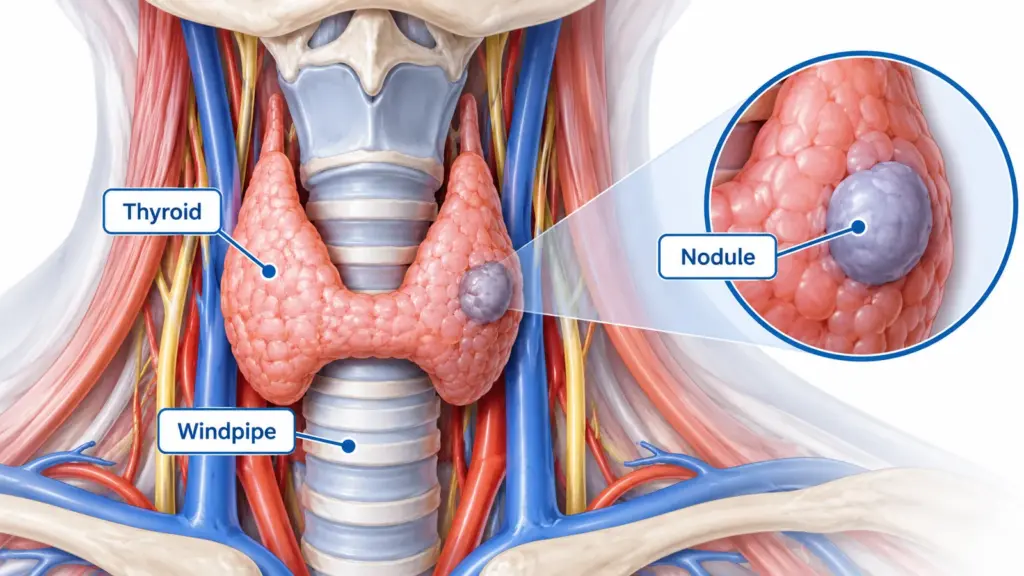
A thyroid nodule often causes no symptoms. When symptoms occur, you may notice a lump low in the front of your neck, pressure from a collar, swallowing discomfort or a change in your voice. These signs deserve assessment, but they cannot tell you whether a nodule is benign or malignant. A normal thyroid blood test does not settle that question either.[1,2]
I separate two concerns when considering a neck symptom: whether it needs prompt attention, and whether the thyroid finding actually explains it. A nodule discovered during a scan may be incidental. Treating that finding without understanding the symptom can leave the original problem unresolved.
This guide explains what to notice and what to bring to an appointment. It is intended for adults with a possible or known thyroid nodule, rather than as a checklist for self-diagnosis. New breathing difficulty needs urgent attention; it should not wait for a routine thyroid appointment.
What can a thyroid-related neck lump feel like?
The thyroid sits toward the lower front of the neck. A nodule is a localized area within it, rather than a name for every neck swelling. You might notice an uneven contour while fastening a necklace or looking sideways in a mirror. Some nodules can be felt during examination; others are too small or too deep to notice.
A clinician checks whether a lump belongs to the thyroid or another structure. An enlarged lymph node, a skin lesion or a different neck mass needs its own assessment. Repeatedly pressing or comparing a lump at home cannot reliably identify its origin.
Write down when you first noticed the change and whether it has visibly enlarged. A description such as “new fullness on one side for three weeks” is more useful than an attempted home measurement. Mention tenderness and recent illness, without assuming either explains the lump.
Can a nodule cause pressure or swallowing discomfort?
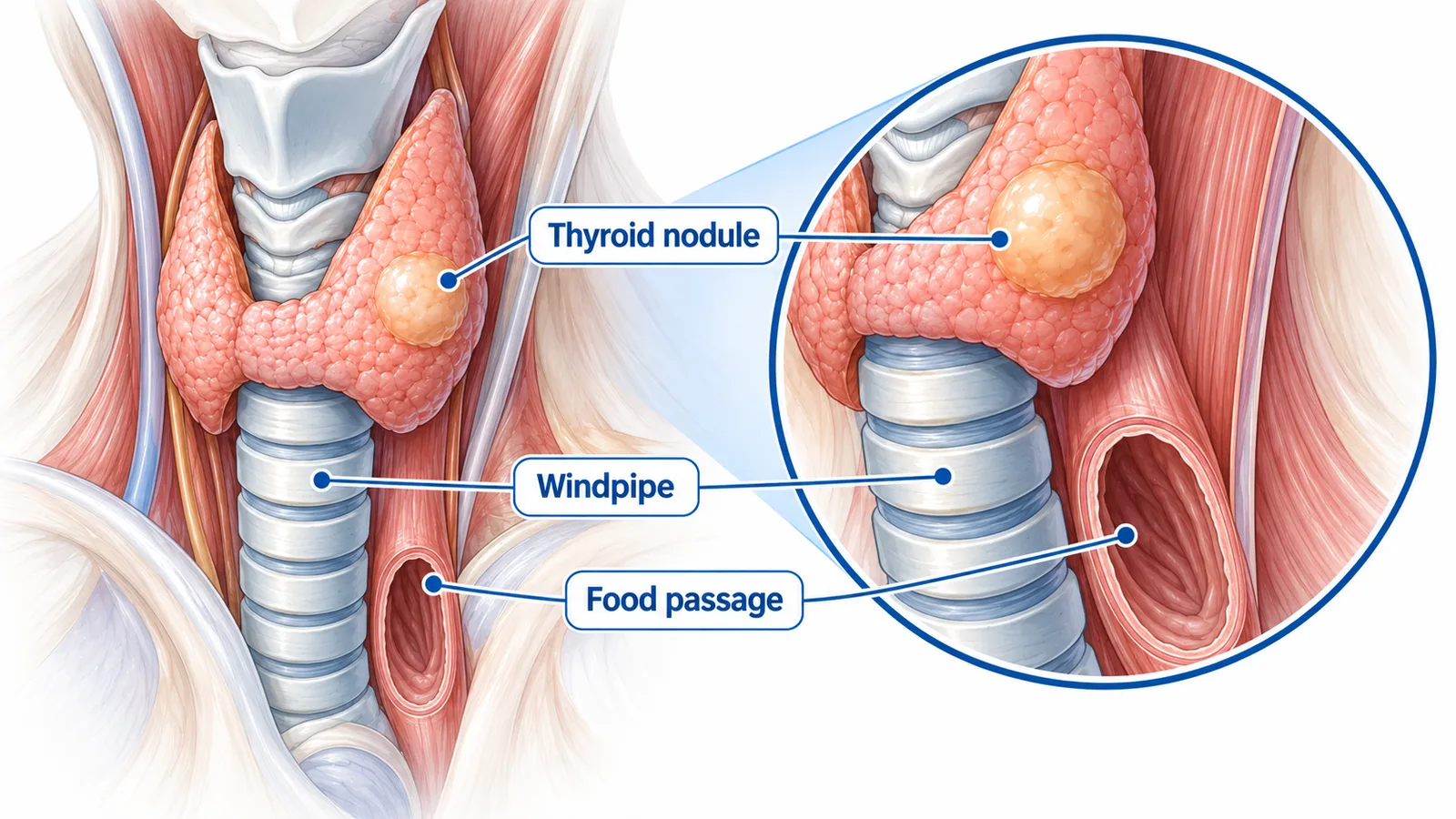
A sufficiently large or strategically located nodule can affect nearby structures. Pressure may be more noticeable when lying down, wearing a tight collar or swallowing. The position of a nodule matters alongside its size: two similarly measured nodules can relate differently to the windpipe and food passage.[3]
Describe the experience precisely. Does food seem to stick, does swallowing hurt, or is there a constant lump sensation between meals? These are different complaints. Throat irritation, reflux and other conditions can coexist with a thyroid nodule, so finding a nodule does not automatically explain every throat sensation.
Bring previous reports if available, especially when symptoms have changed since the last scan. Explain any effect on sleep, eating or ordinary clothing. This helps the clinician judge the burden of symptoms and whether further investigation is needed, rather than choosing treatment from the diameter alone.
What should you do about a change in your voice?
Persistent unexplained hoarseness, a weaker voice or a new change in voice quality deserves medical review. Tell the clinician when it began, whether it is continuous, and whether it preceded the discovery of the nodule. A recent cold may be relevant, but should not become an explanation that prevents reassessment if the change persists.
Neck history matters too. Mention previous thyroid or neck surgery and any earlier vocal-cord problem. Depending on the findings, examination of the larynx and vocal cords may be appropriate. A thyroid ultrasound does not replace that assessment.
A voice change does not by itself diagnose cancer. It is also not a symptom to promise will improve after shrinking a nodule. The reason for the change needs clarification before treatment, particularly if a thyroid procedure is being considered.[4,5]
Are palpitations or fatigue caused by the nodule?
Most nodules do not make excess thyroid hormone. Some functioning nodules can contribute to an overactive thyroid, with symptoms such as palpitations, heat intolerance or tremor. Thyroid function is assessed with blood tests and, in selected circumstances, additional testing. The ultrasound appearance alone cannot establish hormone production.
Fatigue and weight changes have many possible explanations. Avoid using these nonspecific symptoms to decide whether a visible lump is dangerous. A normal thyroid-stimulating hormone result is useful information about function, but does not certify a nodule as benign.
It helps to separate a local symptom diary from a general one. Record neck pressure and swallowing changes alongside palpitations or fatigue, rather than treating them as one diagnosis. Bring medication and supplement information to the assessment; do not change prescribed treatment because of an online symptom list.
Which symptoms should not wait for a routine appointment?
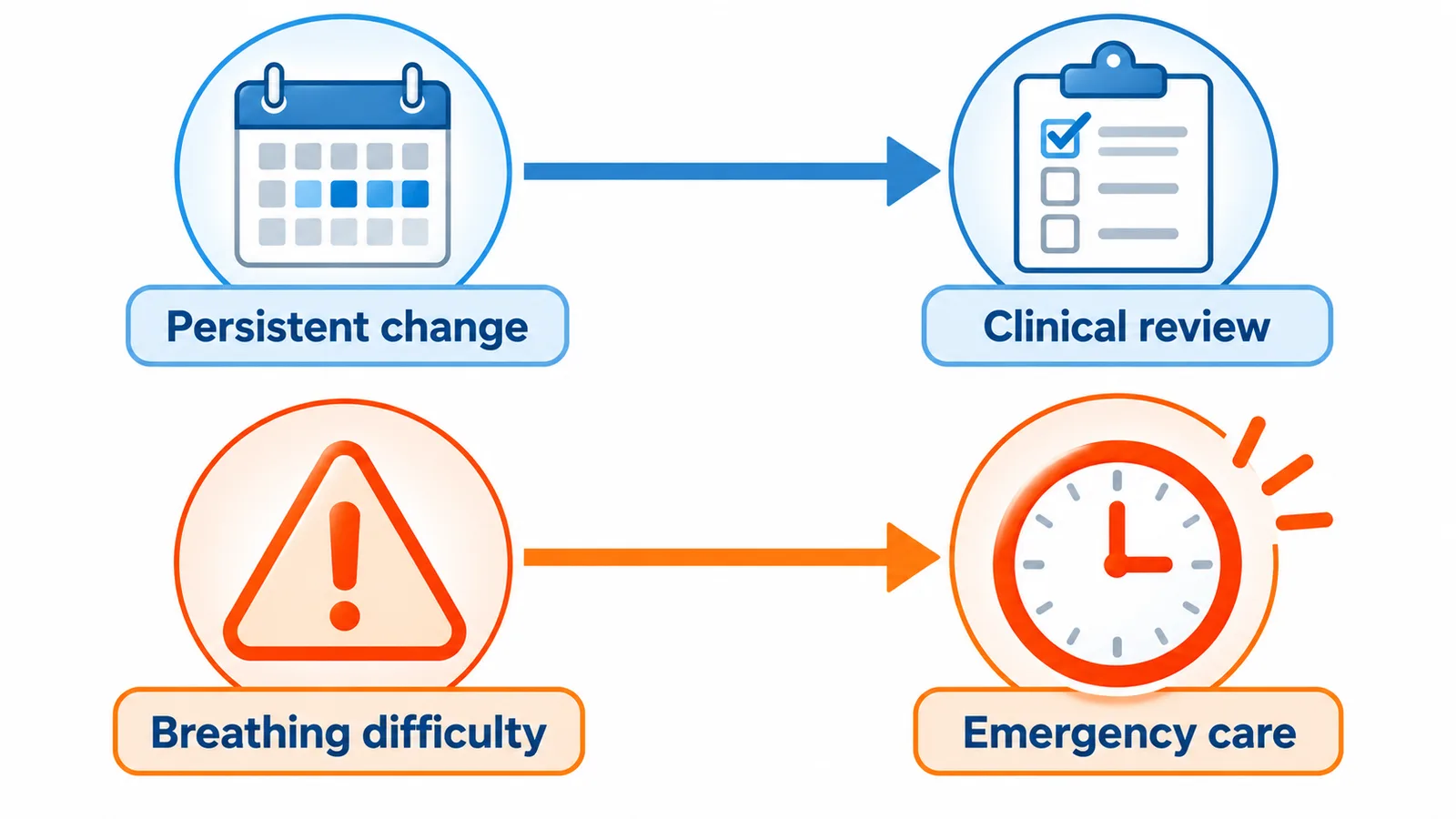
Seek emergency care for difficulty breathing, noisy breathing or an inability to swallow. Rapidly worsening neck swelling with airway or swallowing difficulty needs urgent assessment, even when a previous thyroid test was reassuring. Use your local emergency service rather than waiting for a planned scan.[6,7]
Arrange prompt clinical review for a new or enlarging neck lump, persistent unexplained hoarseness or progressive swallowing symptoms. Tell the service about the change when booking, so the appointment can be triaged appropriately. A routine follow-up date should be reconsidered when the clinical situation changes.
Do not use pain as a reassuring or alarming test by itself. A painful swelling and a painless swelling can each require assessment for different reasons. If symptoms are escalating quickly or you are uncertain about breathing or swallowing safety, seek urgent advice instead of attempting to classify the lump yourself.
How are symptoms and a thyroid nodule assessed together?
Try describing a typical day rather than only the worst moment. Explain whether discomfort occurs with meals, speaking, exercise or certain positions, and whether it is constant or intermittent. If the symptom improved or worsened before any treatment, include that too. This does not diagnose its source, but makes the assessment more specific. When the report and your experience seem unrelated, it is reasonable to ask what additional explanation is being considered before agreeing to a treatment plan.
The starting point is your history and a neck examination. Ultrasound can establish the location of a lump, describe a nodule and evaluate adjacent neck structures. Thyroid blood tests answer a different question about gland function. If biopsy is recommended, it is selected using imaging and clinical information rather than symptoms alone.[8]
Bring the report and, where possible, the actual earlier images. Note previous biopsy results, childhood head or neck radiation and important family thyroid history. Ask which nodule, if there is more than one, best matches the symptom location and which finding is driving the recommendation.
Useful questions include: “What else could explain this symptom?”, “Do I need another assessment before deciding on treatment?” and “What change should make me contact you sooner?” Ask who will communicate the results and arrange follow-up. A clear next step is more helpful than leaving with an unexplained scan label.
How I assess whether a nodule explains your symptoms
My first question is what has changed for you: a visible lump, a swallowing problem, pressure or a voice concern. I then consider whether the symptom location and timing fit the nodule’s position and documented growth. I do not treat the discovery of a nodule as proof that it is responsible for every neck complaint.
Before considering ablation, I need a reliable benign assessment and a meaningful reason to intervene. Pressure, swallowing difficulty, neck discomfort, cosmetic concern or autonomous hormone production can matter, but they are different problems. The ultrasound map and any biopsy results must support the proposed plan; suspicious findings need the appropriate diagnostic pathway first.
I also discuss the limit of intervention. Reducing a nodule may not resolve a symptom arising elsewhere. Observation or another specialist assessment may be more appropriate, while surgery, radioactive iodine or an ablation technique may be considered in selected settings. My aim is to connect a defensible diagnosis with the benefit you are seeking, rather than assume that a visible finding needs removal.[9]
Conclusion
Thyroid nodule symptoms can include a neck lump, pressure and swallowing or voice changes, but many nodules remain silent. The useful next step is an assessment that connects symptoms, anatomy and diagnostic findings. New airway problems require emergency care; persistent changes deserve timely review.
Frequently Asked Questions
Can I have a thyroid nodule without knowing it?
Yes. Many are found incidentally during examination or imaging. Whether a silent nodule needs follow-up depends on its findings and clinical context, rather than whether you can feel it.
Does a neck lump mean thyroid cancer?
No. A lump has several possible causes, including benign thyroid nodules. Examination and appropriate tests identify its origin and whether further investigation is needed.
Can normal blood tests rule out a concerning nodule?
No. Blood tests mainly assess thyroid function. Imaging and, when indicated, biopsy address different questions about a nodule.
Should I wait if my voice has changed?
Persistent unexplained voice change should be assessed. Tell the clinician about its duration and any associated neck swelling, swallowing change or breathing problem.
Will ablation definitely relieve neck pressure?
No outcome can be guaranteed. First establish whether the nodule explains the pressure and whether it meets the separate diagnostic and treatment-selection requirements.
What if breathing becomes difficult before my appointment?
Seek emergency assessment through your local emergency service. Do not wait for the scheduled thyroid appointment or assume an existing benign result makes new airway symptoms safe.
Scientific References
- American Thyroid Association. Thyroid Nodules [Internet]. Accessed 2026 Oct 29.
- Endocrine Society. Thyroid Nodules [Internet]. Accessed 2026 Oct 29.
- Durante C, Hegedüs L, Czarniecka A, et al.. 2023 European Thyroid Association Clinical Practice Guidelines for thyroid nodule management. Eur Thyroid J. 2023;12(5):e230067. doi:10.1530/ETJ-23-0067.
- Haugen BR, Alexander EK, Bible KC, et al.. 2015 American Thyroid Association Management Guidelines for Adult Patients with Thyroid Nodules and Differentiated Thyroid Cancer. Thyroid. 2016;26(1):1-133. doi:10.1089/thy.2015.0020.
- Sinclair CF, Baek JH, Hands KE, et al.. General Principles for the Safe Performance, Training, and Adoption of Ablation Techniques for Benign Thyroid Nodules: An American Thyroid Association Statement. Thyroid. 2023;33(10):1150-1170. doi:10.1089/thy.2023.0281.
- National Health Service. Goitre [Internet]. Accessed 2026 Oct 29.
- National Health Service. Sore throat [Internet]. Accessed 2026 Oct 29.
- Radiological Society of North America and American College of Radiology. Ultrasound – Thyroid [Internet]. Accessed 2026 Oct 29.
- Papini E, Monpeyssen H, Frasoldati A, Hegedüs L.. 2020 European Thyroid Association Clinical Practice Guideline for the Use of Image-Guided Ablation in Benign Thyroid Nodules. Eur Thyroid J. 2020;9(4):172-185. doi:10.1159/000508484.