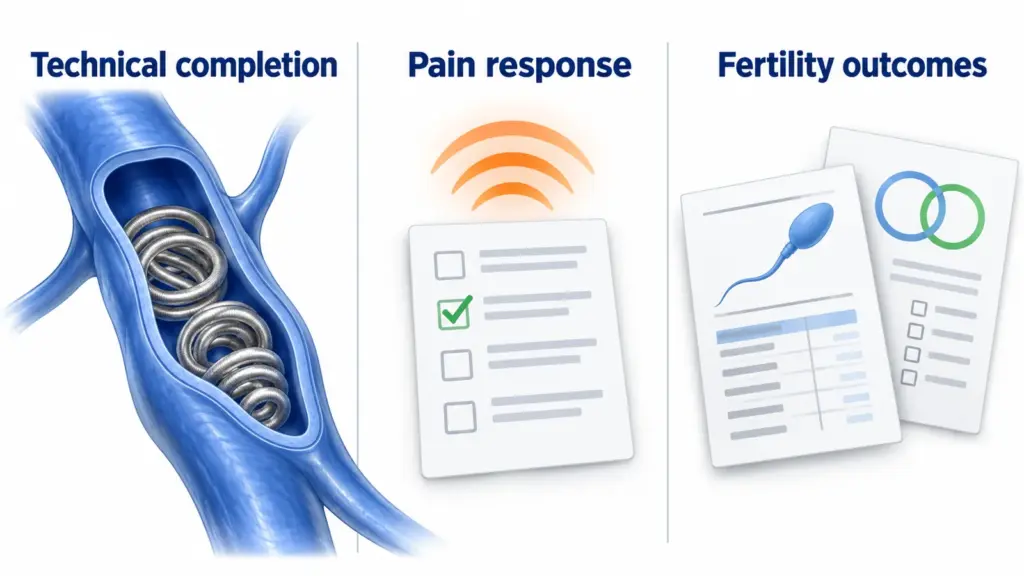
Varicocele embolization success rates do not describe one outcome. A procedure can successfully close a venous pathway while pain persists, a semen result changes without pregnancy, or symptoms recur after an initially helpful response. The useful question is which result was measured, in whom and over what follow-up.
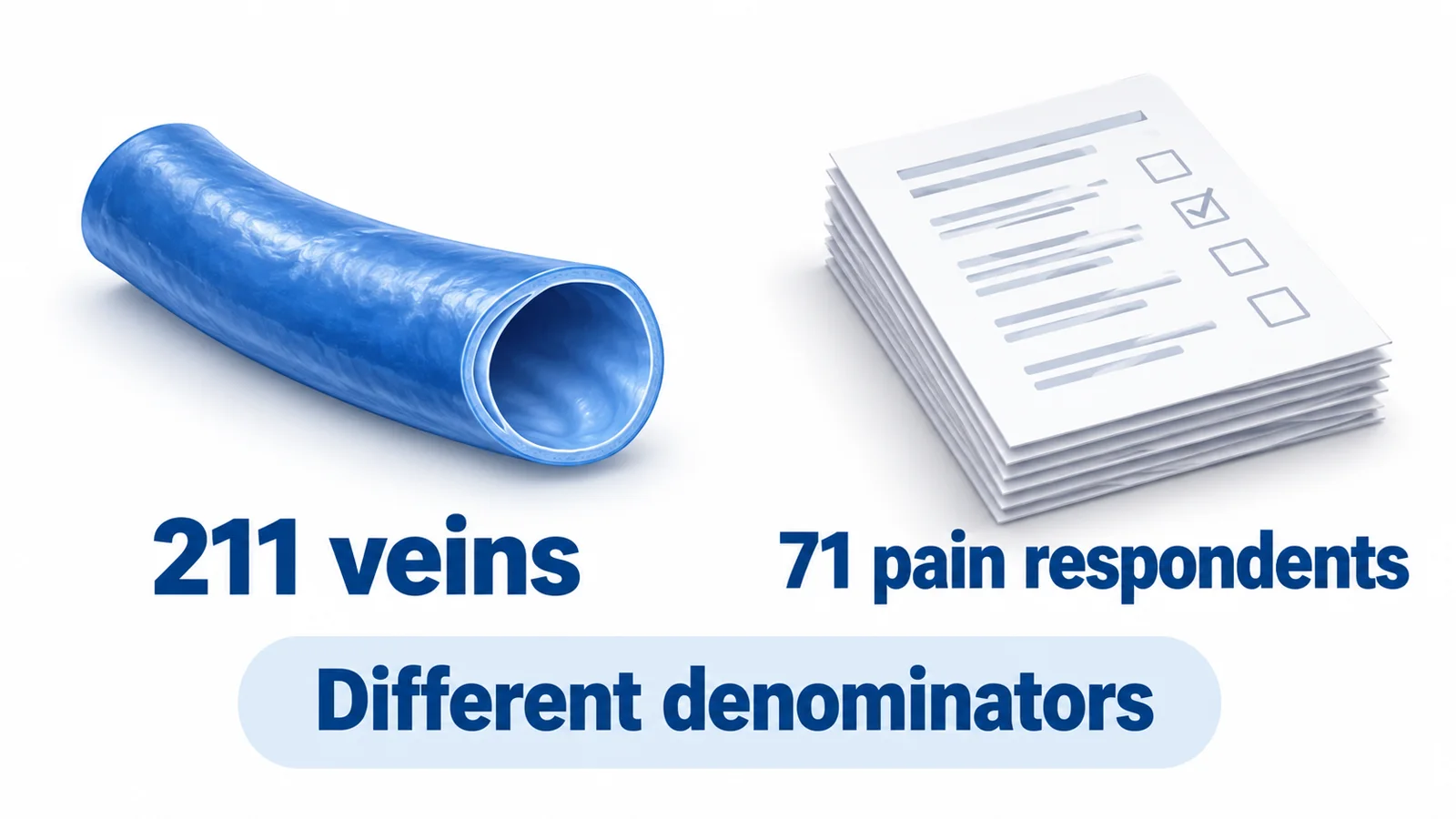
A headline percentage also needs a denominator. Some studies count patients, others treated veins, and others only people who answered a follow-up questionnaire. Those figures cannot be compared as if they describe the same group. A high technical completion rate is not a personal probability of pain relief, pregnancy or live birth.
When I explain a success figure, I connect it to the clinical goal before discussing the number. That keeps expectations realistic and makes the limits of the evidence visible. This guide concentrates on interpreting embolization outcomes, rather than repeating a procedure tutorial or providing a fixed follow-up timetable.
What does technical success actually mean?
Embolization uses a catheter and image guidance to treat selected abnormal venous pathways. Technical success describes accomplishing the intended venous procedure, such as reaching the target and stopping the relevant flow. It does not directly measure how a person feels or whether the reproductive goal has been achieved.
Venous anatomy can affect access and completion. Persistent or recurrent symptoms may also have explanations beyond the treated pathway. The varicocele embolization treatment page explains the procedure and its limitations; avoiding a surgical incision does not make the intervention risk-free or universally suitable.[1]
Ask how a study defined completion. Successful catheter access, placement of material and documented cessation of reflux are related but not identical descriptions. A number is most informative when the intended technical endpoint is stated clearly and complications are reported separately.
Why do reported percentages differ between studies?
A 2025 retrospective adult series reported first-attempt technical success in 216 of 225 patients, or 96%. Its technical definition included gonadal vein access, embolization and abolition of flow in that vein. The study recruited over fifteen years; that is not fifteen years of follow-up for every participant.[2]
The series reported mean follow-up of about eight years, with a minimum of 19 months. That describes available follow-up in a retrospective report, rather than a uniform assessment at the same point for every person.
Another 2025 series included 182 procedures and a mixed age range of 12–71 years. Its technical analysis counted 211 insufficient internal spermatic veins, with success in 186 veins, or 88.15%. That is a per-vein result, not 186 successfully treated people out of 182. The study’s overall median follow-up was 44.5 months.[3]
Different anatomy, selection, operators, endpoints and follow-up methods affect these reports. The percentages should not become an unadjusted ranking of clinics or a personal forecast. The age mix also matters: a cohort containing younger patients does not establish that adult indications apply automatically to adolescents.
How should pain-relief figures be read?
In the 182-procedure study, pain was the original indication in 116 patients, but 71 responded to the telephone assessment. Its clinical success figure was 50 of those 71 respondents: 40 reported complete resolution and ten partial relief with satisfaction. The combined figure therefore does not mean that everyone counted as successful became pain-free.
Nor can the experiences of the 45 people who did not respond be assumed. A study reporting only respondents may overestimate or underestimate the wider group’s result. Definitions, selection and completeness of follow-up matter alongside the percentage.
An older study of 96 selected pain cases reported reduced pain in 74%, including partial improvement, while its table reported complete resolution in 30% overall. The median questionnaire response was at 12 months. It had no untreated control group, and the abstract’s wording about the 30% requires care; the full table is clearer.[4]
These findings support discussing possible benefit with uncertainty. They do not justify a guarantee, a fixed time to relief or applying one cohort’s result to every cause of testicular pain. The original diagnosis and its relationship to the veins remain important.
Are improved semen results the same as fertility success?
No. Semen parameters describe a sample; natural pregnancy, assisted reproduction outcomes and live birth describe different events. The partner’s reproductive factors and the couple’s circumstances can affect the result even if a male laboratory measure improves. A venous procedure cannot be assigned a personal pregnancy probability from a scan alone.
A nonrandomized prospective comparison included 76 infertile men, with 49 receiving microsurgery and 27 embolization. Its semen and spontaneous pregnancy observations cannot establish live birth equivalence between methods. Small, unequal groups and treatment selection limit the comparison.[5]
The Cochrane review found that varicocele treatment may improve pregnancy outcomes in selected subfertile couples, while live birth evidence remained uncertain. Broader surgical or radiological evidence should not be relabeled as proof of embolization-specific fertility equivalence. Ask which method and outcome actually support a quoted claim.[6]
What does recurrence mean in an outcome report?
Recurrence may mean renewed symptoms, ultrasound reflux, another palpable finding or a repeat intervention. Persistence means the intended problem did not resolve; it is not necessarily the same as recurrence after an initial response. Compare studies only after identifying which definition each used.
The 225-patient series obtained telephone responses from 96 people. Twenty-four reported possible recurrence; twelve attended repeat ultrasound, and six had recurrence confirmed. Its reported ultrasound-based fraction of six out of 96 must be read with that incomplete reassessment in mind. The unexamined people cannot simply be treated as proven free of recurrent reflux.
Similarly, the 182-procedure series had follow-up ultrasound available for only 78 patients, assessed at three to six months. An imaging endpoint in that subset is different from a symptom endpoint among telephone respondents. The existence of several follow-up groups should be made visible, not hidden under one success label.
Recurring discomfort does not establish its cause or automatically require repeat embolization. A reassessment should consider the clinical concern, the venous findings and other explanations. The same principle applies when an ultrasound still describes enlarged veins but the original symptom has improved.
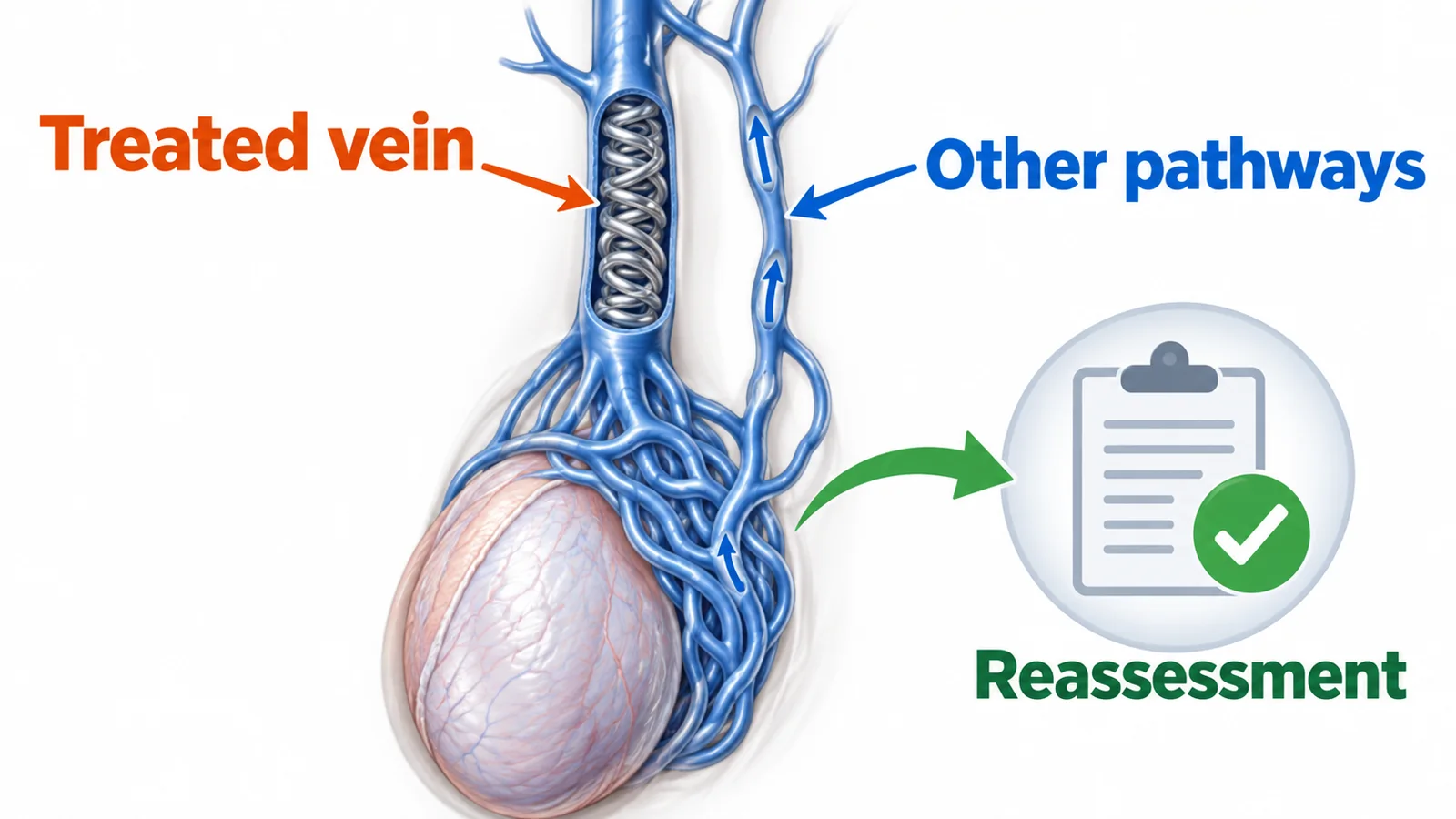
How I explain a result without turning it into a personal promise
I start with the concern that led to the discussion. If pain is the concern, I want an outcome definition that describes the original discomfort and its effect on life. If fertility is the concern, I distinguish laboratory changes from conception and live birth within the couple’s assessment.
I then ask who is included in the number. Patients, treated veins and follow-up respondents cannot be substituted for one another. A technically completed treatment is meaningful, but it cannot supply information that the study did not collect or replace the clinical reason for intervening.
Where Doppler informs assessment, reflux under stated conditions, both sides, testicular volume and accompanying findings help put the result in context. I look for a reasonable relationship between a clinically meaningful varicocele and the concern being addressed. Neither a diameter nor a high published success figure establishes that relationship by itself.
My explanation includes the limits: the relevant population, method, follow-up and missing information. Current guidance distinguishes clinical findings from imaging-only observations and selected fertility indications. These boundaries should remain attached to the evidence, rather than being removed to make a percentage sound more reassuring.[7–9]
Which questions make a quoted rate useful?
Ask what success meant, whether the study counted everyone treated, and how long the relevant group was followed. Ask whether the figure concerns a first procedure or includes repeat attempts, and whether it measures pain, imaging, semen, pregnancy or live birth. The answers can change the meaning substantially.
Also ask how complications and missing follow-up were handled. A retrospective series may provide valuable experience while still having selection, reporting or response limitations. Its result should be presented as evidence with a defined scope, not as a performance promise for an individual patient.
For your own planning, agree which concern would be reassessed if symptoms persist or circumstances change. This guide does not turn study follow-up intervals into a personal schedule; those arrangements need to fit the actual treatment and clinical goal.
Conclusion
Varicocele embolization success figures are useful only when the outcome, denominator and follow-up are clear. Technical completion, pain relief, fertility outcomes and recurrence answer different questions. Keeping those distinctions visible supports realistic expectations without dismissing potential benefit or promising a particular result.
Frequently Asked Questions
Is technical success the same as pain relief?
No. Technical success describes accomplishing the venous procedure. Pain relief is a clinical outcome that needs its own definition and follow-up.
Why can two studies report different rates?
They may study different people, anatomy, methods or outcomes. They may also count treated veins rather than patients, or report only those who answered follow-up.
Does a pain improvement percentage mean complete relief?
Not necessarily. Some studies combine complete relief with partial improvement and satisfaction. Check the definition before interpreting the number.
Does a pregnancy rate prove a live birth benefit?
No. Pregnancy and live birth are distinct outcomes, and the evidence may be uncertain or method-specific. Partner factors and study selection also matter.
Does recurrence automatically mean another procedure?
No. Symptoms, clinical examination and relevant imaging need to establish what persists or has returned. The cause and the treatment goal should be reassessed before another intervention.
Scientific References
- British Society of Interventional Radiology. Varicocele Embolisation. current online leaflet. Accessed 2026 Oct 30.
- de Grae MNM, Al-Khattab M, Alkadhimi A, Springael M, O'Sullivan G. A fifteen-year retrospective analysis of varicocele embolization: evaluating success, recurrence rates and embolic agents. CVIR Endovasc. 2025;8(1):59. doi:10.1186/s42155-025-00575-6.
- Haroun P, Murgo S, Mjaess G, Roumeguère T, Tannouri F. Percutaneous Embolization for Painful Varicocele: An 8-Year Tertiary Centre Experience. J Belg Soc Radiol. 2025;109(1):2. doi:10.5334/jbsr.3769.
- Muthuveloe DW, During V, Ashdown D, Rukin NJ, Jones RG, Patel P. The effectiveness of varicocele embolisation for the treatment of varicocele related orchalgia. Springerplus. 2015;4:392. doi:10.1186/s40064-015-1177-2.
- Bou Nasr E, Binhazzaa M, Almont T, Rischmann P, Soulie M, Huyghe E. Subinguinal microsurgical varicocelectomy vs. percutaneous embolization in infertile men: Prospective comparison of reproductive and functional outcomes. Basic Clin Androl. 2017;27:11. doi:10.1186/s12610-017-0055-x.
- Persad E, O'Loughlin CA, Kaur S, Wagner G, Matyas N, Hassler-Di Fratta MR, et al. Surgical or radiological treatment for varicoceles in subfertile men. Cochrane Database Syst Rev. 2021;4:CD000479. doi:10.1002/14651858.cd000479.pub6.
- European Association of Urology. EAU Guidelines on Sexual and Reproductive Health: Male Infertility. 2026 limited update. Accessed 2026 Oct 30.
- American Urological Association; American Society for Reproductive Medicine. Diagnosis and Treatment of Infertility in Men: AUA/ASRM Guideline. 2020; amended 2024. Accessed 2026 Oct 30.
- Bertolotto M, Freeman S, Richenberg J, Belfield J, Dogra V, Huang DY, et al. Ultrasound evaluation of varicoceles: systematic literature review and rationale of the ESUR-SPIWG Guidelines and Recommendations. J Ultrasound. 2020;23(4):487-507. doi:10.1007/s40477-020-00509-z.