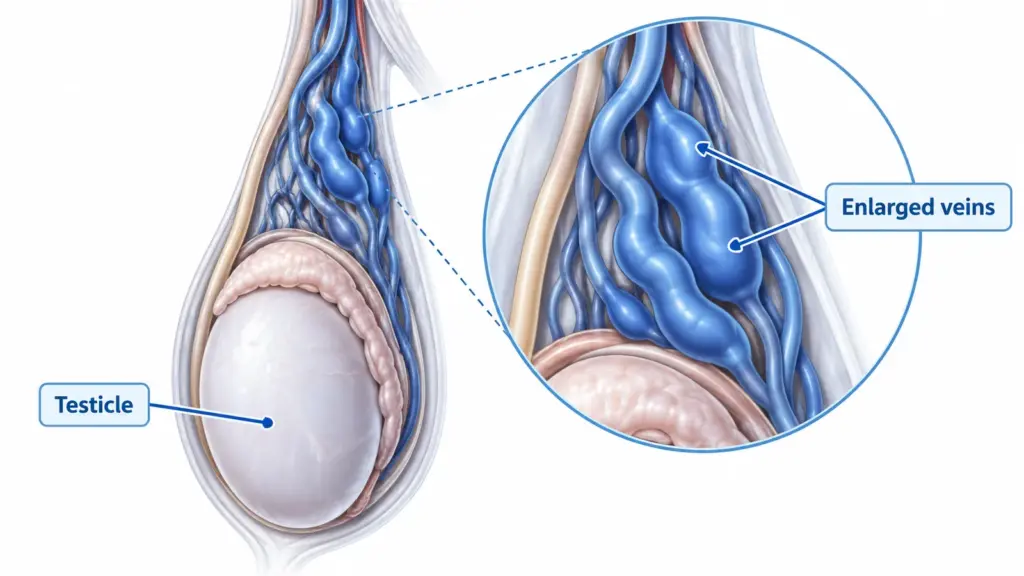
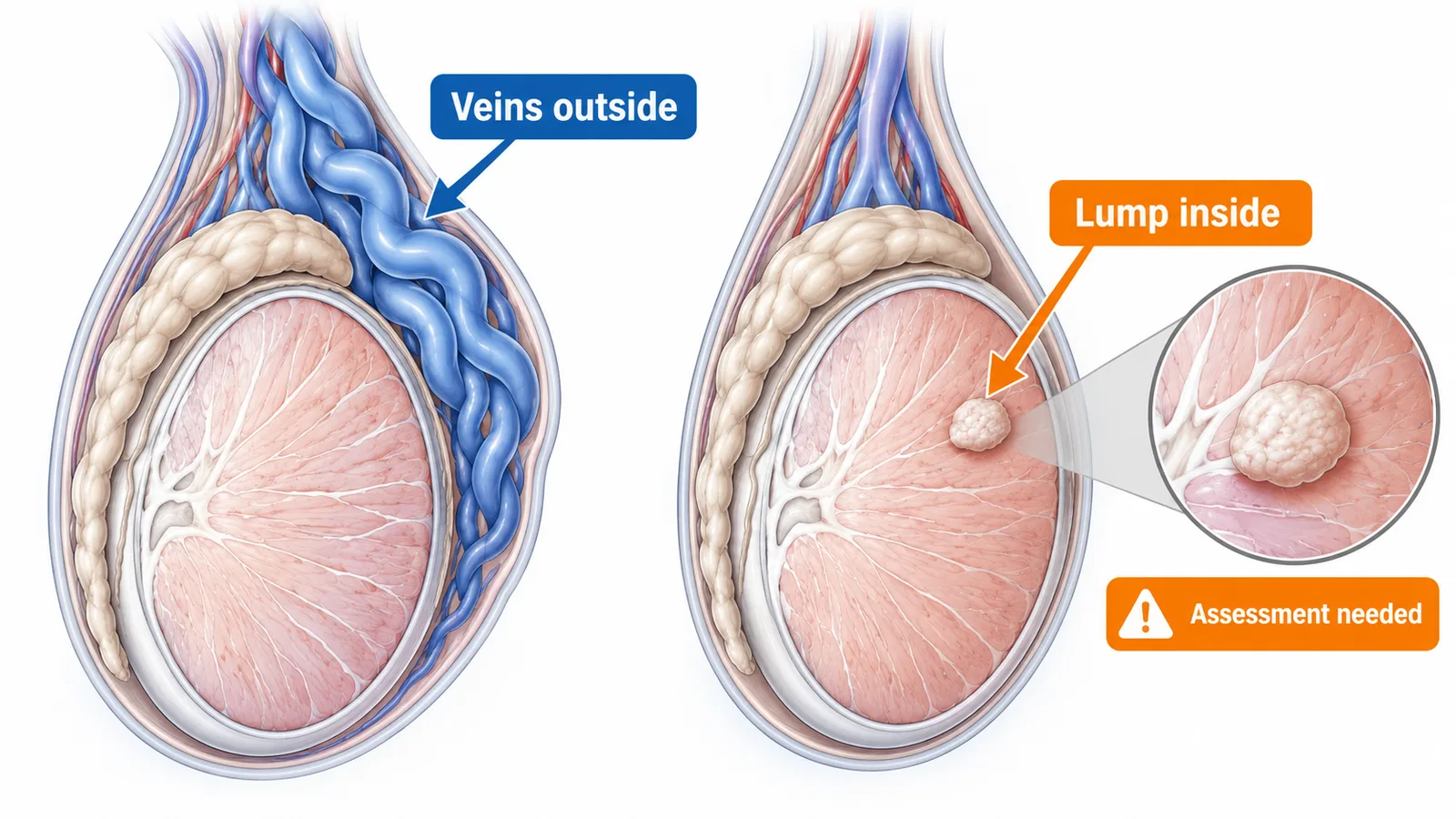
Varicocele symptoms can include a dragging ache, a feeling of heaviness, or soft enlarged veins above a testicle. Some people notice swelling after a long day on their feet; others have no discomfort and learn about a varicocele during a fertility assessment. A varicocele is an enlargement of veins that drain the testicle, rather than a lump growing inside it.
These patterns can help explain a concern, but they cannot confirm the diagnosis. Sudden, severe testicular pain needs emergency assessment, even if you already know you have a varicocele. Gradual symptoms also deserve an examination when they are new, persistent, or associated with a change in testicular size.
The useful first step is to separate a familiar, posture-related ache from a new problem, then establish whether enlarged veins explain the symptoms. This guide focuses on recognizing signs and deciding how promptly to seek care. It does not provide a home diagnosis or assume that every varicocele needs treatment. My starting point is whether the symptom pattern and the examination support the same explanation.
What symptoms can a varicocele cause?
The typical complaint is a dull ache or dragging sensation around the testicle, sometimes extending into the groin. It may be intermittent rather than constant. Standing, exertion, or the end of the day can make it more noticeable, while lying down may reduce it. This pattern is compatible with a venous problem, but is not specific enough to identify the cause by itself.[1]
Describe the sensation in your own words. A clinician benefits from knowing whether it is an ache, a sharp pain, pressure, or tenderness to touch. Note which side is affected and whether the discomfort interrupts work, exercise, sleep, or sexual activity. These details help avoid attributing every sensation to a scan finding.
You do not need to provoke symptoms repeatedly to make them convincing. A brief description of ordinary episodes is more useful than repeatedly straining or pressing the area.
For example, explain whether discomfort starts while standing at work and settles after resting, or whether it persists regardless of position. Mention whether the pattern has been stable for months or changed over a few days. Neither story proves a varicocele, but the difference changes what the clinician needs to investigate.
What might you notice above the testicle?
Enlarged veins can feel soft and winding, usually above or behind the testicle. A larger varicocele may be visible when standing. People sometimes describe a cluster of cords, but that description is not a diagnostic test. Normal structures, cysts, fluid collections, and other conditions can also produce an unfamiliar feeling.
A new lump, a change in the shape of a testicle, or swelling that does not settle should be checked. A firm area within the testicle should not be assumed to be a varicocele. Although many swellings have benign explanations, an examination is needed to distinguish them safely.[2]
Can a varicocele exist without symptoms?
Yes. Some varicoceles are discovered during an examination or investigation for another reason. Lack of pain does not prove that a finding is irrelevant; equally, an incidental finding does not establish a future fertility problem. The significance depends on the whole assessment, including examination and, when relevant, semen testing.
One testicle appearing smaller may prompt assessment, particularly during adolescence. In adults, a clinician can consider whether a size difference is longstanding, reliably measured, and associated with other findings. Photographs or comparisons in a mirror cannot reliably establish testicular volume or the reason for an asymmetry.[3]
If fertility is the reason for the appointment, say so even when you have no discomfort. If fertility is not currently a concern, you can still discuss what monitoring, if any, makes sense for your circumstances.
Which symptoms need urgent attention?
Seek emergency assessment for sudden severe testicular pain, especially with nausea, vomiting, or abdominal pain. Testicular torsion, in which the spermatic cord twists, is one possible emergency. Do not wait to see whether lying down helps, and do not delay emergency assessment while arranging a routine ultrasound or varicocele consultation.[4]
Fever, redness, urinary symptoms, or rapidly increasing swelling also need prompt medical advice. A new change is important even if previous symptoms were mild. Tell the clinician about injury, recent procedures, and whether the current pain differs from your usual pattern.
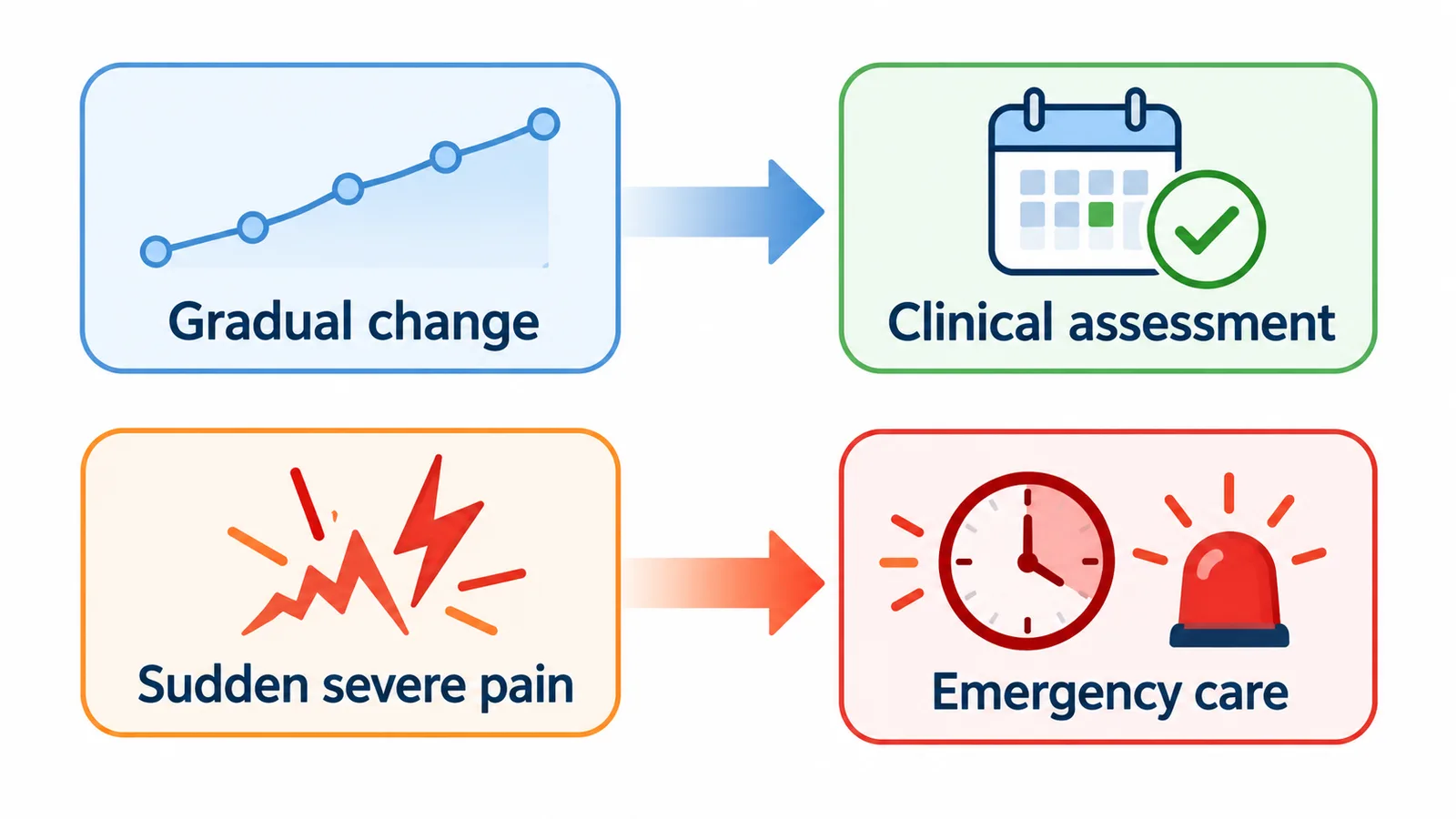
A useful distinction is the speed of onset, rather than how large the veins look. A small known varicocele does not protect against another condition, and a large one does not automatically explain an acute episode. When uncertainty involves sudden pain, urgent clinical assessment takes priority over trying to identify the cause yourself.
How are symptoms assessed?
A clinician asks about timing, posture, activity, previous operations, and reproductive goals, then examines the testicles and surrounding structures. Examination may include standing and a brief bearing-down maneuver. Ultrasound can clarify uncertain findings, assess testicular tissue and volume, or investigate another suspected cause. It is not automatically required for every fertility consultation.[5,6]
Bring previous reports if available, but do not assume that a measured vein diameter explains the symptoms. The clinician needs to match the reported side and blood-flow findings to the examination. If the discomfort is on the opposite side, or has an unusual character, that mismatch deserves attention.
Useful questions include: Is the abnormality in the veins or in the testicle? Does the examination reproduce the familiar discomfort? Is another cause more plausible? What finding would change the plan? These questions keep the assessment focused on your concern rather than on treating an isolated label.
When do symptoms make treatment worth discussing?
Persistent discomfort that fits the clinical findings may justify discussing treatment after alternative causes have been considered. Fertility concerns require a different conversation: examination, semen results, the couple’s circumstances, and time available for treatment all matter. Current guidance distinguishes a palpable varicocele from veins found only on imaging; these are not interchangeable treatment indications.[7]
Observation can be reasonable when symptoms are limited and no other concerning finding emerges. Supportive measures may help comfort, but they do not establish the diagnosis or reliably correct abnormal venous flow. Avoid buying supplements or restrictive devices on the assumption that they will cure the underlying problem.
If intervention is considered, ask what outcome it is intended to improve. Relief of an ache, changes in semen parameters, and achieving a pregnancy are different outcomes. No procedure can guarantee all of them, and discomfort may persist if another condition contributes.
How I assess varicocele symptoms
When I assess varicocele symptoms, the first question is whether the enlarged veins plausibly explain the concern. The location, onset, posture-related pattern, and effect on daily life matter more than how prominent a vein looks. A known varicocele should leave room for another diagnosis when a symptom is new or different.
I consider the history alongside a standing examination and testicular findings. When Doppler is indicated, vein diameter is only part of the picture: reflux, findings on both sides, testicular volume, and other scrotal abnormalities help put the result in context. A reassuring-looking measurement cannot replace an explanation of the symptom.
The next decision is what, if anything, needs to change. Limited symptoms with no other concerning finding may support observation. Persistent characteristic discomfort, a relevant testicular finding, or a fertility concern can justify further discussion. Before considering intervention, I look for a reasonable connection between the clinical finding and the problem treatment is intended to address.
For follow-up, I focus on that original goal. If discomfort is the concern, its effect on ordinary activities matters; if fertility is the concern, the relevant reproductive assessment matters. The plan should explain what remains uncertain and what change would lead to reassessment.
You can review my clinical background and bring previous reports and a short symptom history to a planned assessment.
My broader approach to treatment decisions explains how I weigh these findings against your goals.
Conclusion
Varicocele symptoms can include a posture-related ache, heaviness, and soft enlarged veins, but many people have no symptoms. Recognition is useful because it guides an examination; it cannot replace one. New persistent changes deserve assessment, while sudden severe pain requires emergency care.
Frequently Asked Questions
Can a varicocele hurt only after standing?
Yes, that pattern can occur. It is still important to confirm the cause, especially when the discomfort is new or changing.
Does no pain mean fertility is normal?
No. Symptoms cannot measure sperm production. Fertility assessment depends on reproductive history and appropriate testing, rather than the presence or absence of an ache.
Can I diagnose a varicocele by touch?
You may notice a change, but several structures and conditions can feel similar. Arrange an examination rather than repeatedly squeezing or testing the area.
Should I wait for a scan if pain starts suddenly?
No. Sudden severe pain needs emergency assessment. A routine scan appointment is not a safe substitute for timely evaluation.
Does every symptomatic varicocele need embolization?
No. The diagnosis, alternative causes, symptom burden, fertility findings, and your preferences determine whether observation or an intervention is appropriate.
What if a lump feels hard rather than soft?
A distinct hard lump, particularly within the testicle, needs prompt clinical assessment. Do not assume a previously diagnosed varicocele explains a new lump.
Scientific References
- Lundy SD, Sabanegh ES Jr. Varicocele management for infertility and pain: A systematic review. Arab J Urol. 2018;16(1):157-170. doi:10.1016/j.aju.2017.11.003.
- National Health Service. Testicle lumps and swellings. NHS; accessed 2026 Oct 29.
- European Association of Urology. EAU Guidelines on Sexual and Reproductive Health: Male Infertility. Current online guideline; accessed 2026 Oct 29.
- National Health Service. Testicle pain. NHS; accessed 2026 Oct 29.
- American Urological Association; American Society for Reproductive Medicine. Diagnosis and treatment of infertility in men: AUA/ASRM guideline. 2020; amended 2024.
- Bertolotto M, Freeman S, Richenberg J, et al. Ultrasound evaluation of varicoceles: systematic literature review and rationale of the ESUR-SPIWG Guidelines and Recommendations. J Ultrasound. 2020;23:487-507. doi:10.1007/s40477-020-00509-z.
- World Health Organization. Guideline for the prevention, diagnosis and treatment of infertility. Geneva: WHO; 2025. Chapter 9: Treatment of infertility due to male factors.